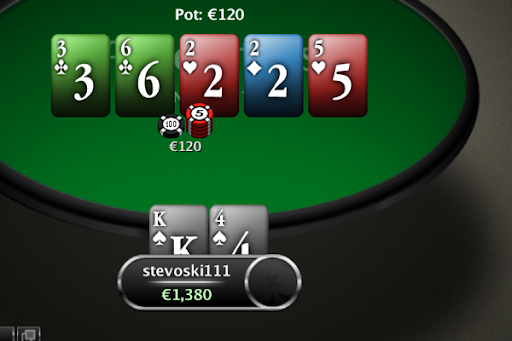
PartyPoker has introduced “FastForward Poker”. Unfortunately, here in Spain, PartyPoker’s Mac client is unavailable since the introduction of a Spanish law a couple of months ago that regulates online poker. So I can’t try out this “FastForward Poker”.
Can anyone tell me, is that simply an equivalent of PokerStars’ “Zoom Poker”?
More than 50 people have signed up to be notified when SeeingStars (Real Time Odds for PokerStars) is released AND receive 50% off the initial purchase price). That’s good. For me, this is validation that this is a product people are interested in.
The continuing story of creating a tool called SeeingStars, offering real time odds for PokerStars. Read from the beginning here.
If you need to evaluate poker hands on a computer quickly and reliably, you need poker-eval. It is highly-optimised C library to evaluate poker hands. I suspect it is used by most poker software and poker rooms.
I added poker-eval to SeeingStars to evaluate hands that go to the flop, turn, and river. I use the Monte Carlo method for the flop and turn, but once the hand goes to the river, it is quick to evaluate every possible combination.
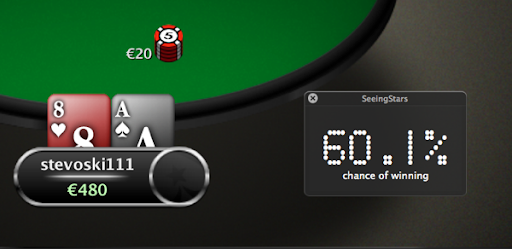
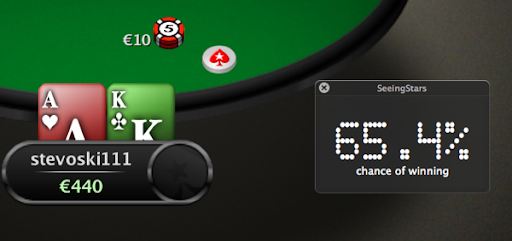
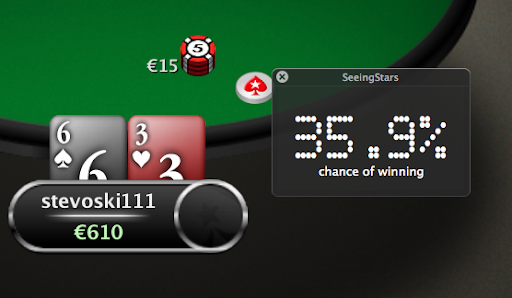
Once I added poker-eval to SeeingStars, I had real-time odds fully functioning. Here’s a video I made of a heads-up SNG I played today. with real-time odds:
As you can see, I have a proof-of-concept working. That is just the beginning of the required work. There are remaining steps to make this useful more generally, including quality control, packaging, getting a logo, producing a website, working with smaller window sizes, supporting different PokerStars room themes, tables other than heads-up tables. Then I have to decide if I should charge money for this, as a stand-alone product, or whether it belongs in PokerZebra. Can I sell it in the Mac App Store, or do sandbox restrictions get in the way? How much will this add to my workload?
Would you pay money for a fully working SeeingStars? Say 10 dollars/10 euros? Without financial incentive I’m unlikely to spend too much time finishing this proof-of-concept.
My friend Valentina Pokerina is a rare combination: she plays poker well and teaches well – in five or six languages. She lives here in Barcelona and runs regular poker workshops. Mostly in Spanish, but also in English. Heck, ask her, and she’ll teach you poker in Catalan, German, or Portuguese. And French too, I think.
And if you are a poker bigwig, I bet she is willing to travel to run poker workshops.
The continuing story of creating a tool called SeeingStars, offering real time odds for PokerStars. Read from the beginning here.
Calculating odds can be time-consuming. A short-cut preflop is to use pre-calculated tables. I found a table of preflop odds for all starting hands here. I copied this into SeeingStars, and created some code to look up in this table your starting hand by # of players. It works well, and outputs as follows:
But who wants to read tiny text while playing? I made a HUD-style window, found a scoreboard style typeface, and displayed the number in a large size:
Not looking too bad, I think.
However this is only working preflop. After the flop, turn and/or river are revealed, it is more complicated. A look-up approach would require more than 500 billion recalculated values. Two possible approaches are
iterate through all opponent cards and all possible outcomes. This takes too long, so I won’t do this.
I think with the Monte Carlo method the odds calculated by sampled values will soon approach the actual odds. The trick is determining the amount of possible outcomes to sample that balances time constraints and accuracy.
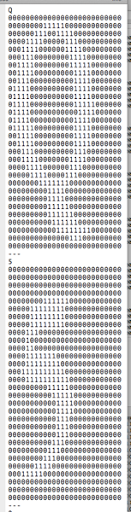
I played on PokerStars for a couple of hours while my embryonic program grabbed screenshots, turned it into a string of 1’s and 0’s, then saved it. I now had a corpus of screen scrapings. Using a text editor, I manually augmented the text file with the character I could see. For example, a section of the text file looks like this:
It’s a manual way of training a computer to do optical character recognition.
Now I can compare future scraped characters to this corpus to find out what character it is.
The process of scraping doesn’t always return identical matches; sometimes the character ‘Q’ might have a couple more 1’s or a couple more 0’s. So I compare the scraped stream of 1’s and 0’s with my corpus using an “edit distance” algorithm. If the edit distance of the scraped text from an item in the corpus is no more than 4, then I count it as a match.
Let’s fire up PokerStars, play a hand, and see what SeeingStars does so far. Here’s the table:
Estoy empezando a utilizar poker copilot y tengo problemas para poder subir mi historial. Solicito el historial en PokerStars, me da el formato csv. pero cuando entro en copilot y le doy a exportar el archivo, este me aparece pero no me lo deja seleccionar. Alguien me podria indicar como debo de hacerlo?