AskDifferent is a new site to help and get helped with Mac software and hardware issues. It is modelled on StackOverflow, the successful programmer’s Q&A site.
I asked a question last night before going to bed. The correct answer was waiting for me when I awoke. Let’s see if it continues to be so helpful.
I submittedPokerZebra to the Mac OS X App Store. I spent 12 days “waiting for review”. Once the review started, within an hour the app was rejected. And fairly. The reason:
…if the user closes the application there is no way for the user to reopen the app without having to quit and then relaunch the application.
I like this. There are a set of automated and manual checks for the quality and conformity of an app in the App Store.
I’ve made the necessary changes and resubmitted. I suspect I’ll need to wait another couple of weeks to find out if PokerZebra is approved.
What has this to do with Poker Copilot? Simply this: the turn-around times are too long. When Full Tilt or PokerStars release an update that breaks Poker Copilot, I can’t wait 12 days for a review of the update by Apple. That’s 12 days of no head-up display (HUD) for Poker Copilot users. Even I changed Poker Copilot to meet Apple’s technical requirements – or Apple’s technical requirements for the App Store changed, it is simply not a workable system. Perhaps if there were expedited reviews of software updates it would be possible.
These tournaments report their results differently. Normally the Full Tilt tournament summaries state:
stevoski111 finished in 37th place.
In Multi-Entry Tournaments it can read
stevoski111 finished in 37th and 111th place.
I need a collection of these tournament summaries to be able to fully test how Poker Copilot handles them. If you’ve played in Full Tilt Multi-Entry Tournaments, please send me your tournament summaries to steve@pokercopilot.com. This will make it much easier for me to add reliable support.
I especially am looking for tournaments where you finished in the money with one or more entries, and tournaments where two of your entries were merged because the number of tables remaining was less than your number of entries.
Using and understanding how to leverage the use of your HUD is the main reason of success for the vast majority of poker players. It speeds up you learning so fast it often pays for itself in days. The fact that it is so cheap is just amazing.
I think I would be a winning player without a HUD but the day I got my first poker software (called Poker Copilot for Mac) I instantly found and fixed a bunch of leaks in my game.
You can not underestimate how valuable it is, it is better than any book or poker video for the same price.
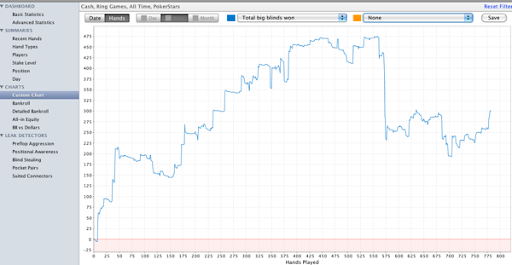
I’d really like to see a graph in BBs as I play both $.1/$.25 and $.25/.50 and I try not to worry how much money I’m making but rather how many stacks I’m winning.
Normally I’d add such a request to the queue of things to consider for future updates. But it seemed like a reasonable addition that I could do in ten minutes, due to the way charts are configured. So here it is:
I’m experimenting with Elance as a way to outsource some aspects of running Poker Copilot. The first experiment is commissioning some content for http://macpokersoftware.com/. If you can write well and play online poker on your Mac, take a look at my posting asking for reviews of Carbon Poker and Lock Poker.
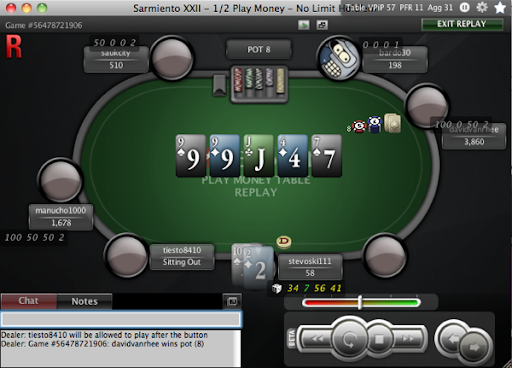
Loyal Poker Copilot customer Jon pointed out something I had never realised: until a recent update of Poker Copilot, it was adding HUD stats to the PokerStars hand replayer.
This accidental feature has now been reinstated as an official feature.
This feature relies on an observation that the hand replayer always has an aspect ratio of nearly 1.45:1, once you remove the window title bar from the calculations. If this doesn’t hold for all table themes, or is changed in the future by PokerStars, then the feature will break. Such is the nature of hooking into third-party applications on an ad-hoc, informal basis. They change; your software breaks.
Though [Facebook’s Chief Security Officer Joe] Sullivan is the unflappable type, the Tunisian situation seemed to force him into a bit of reflection. “When you step back and think about how Internet traffic is routed around the world, an astonishing amount is susceptible to government access,” he noted.
Like most popular journalism on such themes, the technical details are inaccurate (an ISP ‘keylogging’, and being defeated by HTTPS?). But close enough. A disturbing issue for me is the claim that Facebook, which contains so many personal details for many of us, allows – and defaults to – logging in on a non-HTTPS webpage. Can that really be true? Surely this is another inaccurate technical detail. Surely?
The big news in recent weeks for Mac OS X software developers is the release of the App Store for Mac OS X applications. It’s modelled on the iPhone/iPad app store. Developers are asking themselves, should I move my software to the App Store? Is it worth giving Apple a 30% cut (the non-negotiable terms set by Apple) of each sale? Will my app pass Apple’s rigorous review process?
Poker Copilot is built on Java. The App Store guidelines explicitly prohibits software built on Java, so there is an easy answer to the question, “shall I move Poker Copilot to the App Store?” Apple, however, over time may change their policy so I may still have to pose this question in the future.
To get a feel for the App Store from a software developer’s perspective, I’m moving PokerZebra to the App Store. I’m also making it a paid application for US$4.99/ EUR3.99/GBP2.99/AUD5.99. (The connection between these prices is set by Apple – I merely choose a pricing “Tier”). So far the process has been smooth, although I’m waiting, waiting, waiting for Apple to review PokerZebra, a necessary step to making it available.
I’m learning for a customer’s perspective how frustrating it is to not have any information while waiting. I’d love to know how far I am in the queue of waiting applications. Waiting is easier, I think, if one has a sense of moving forward in the waiting queue.